
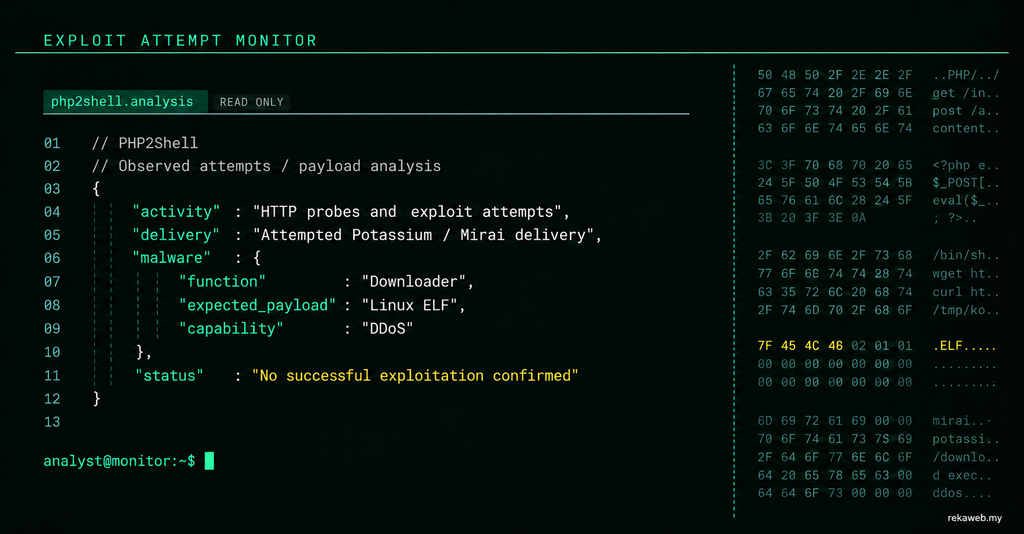
A new wave of cyberattacks targeting critical PHP vulnerabilities has raised serious concerns across the global cybersecurity community. The vulnerabilities, collectively known as PHP2Shell, have reportedly attracted millions of exploitation attempts, with attackers attempting to deploy malware associated with the notorious Mirai botnet.
The attacks highlight the risks faced by businesses, website owners, and organizations relying on PHP-powered platforms, including WordPress, Laravel, and custom web applications.
While widespread successful exploitation has not been confirmed, the volume of malicious activity demonstrates how quickly attackers can attempt to weaponize newly disclosed security flaws.
What Is PHP2Shell?
PHP2Shell refers to two critical vulnerabilities affecting the PHP engine:
- CVE-2026-109618
- CVE-2026-109619
Both vulnerabilities have received a CVSS v4.0 severity score of 9.2 out of 10, placing them in the critical category.
These security flaws may allow unauthenticated remote code execution (RCE) through specially crafted HTTP requests. If successfully exploited, attackers could execute malicious commands with the privileges of the affected PHP process.
Depending on the server configuration, this could expose sensitive application files, database credentials, API keys, and internal services.
Unlike vulnerabilities found in individual WordPress plugins or Laravel packages, PHP2Shell affects the underlying PHP engine itself.
Millions of Exploitation Attempts Detected Worldwide
Following the public disclosure of PHP2Shell, cybersecurity researchers observed a rapid increase in scanning and exploitation attempts.
According to Cloudflare, tens of thousands of attempts were detected within approximately 45 minutes of the announcement. The activity increased to hundreds of thousands within two hours and reached millions by early October 22, 2026.
Censys also reported that more than 34.4 million PHP services were assessed as potentially vulnerable as of October 23, 2026.
However, an important distinction must be made: millions of exploitation attempts do not mean millions of successful server compromises.
Security researchers reported that much of the activity involved automated vulnerability scanning, PHP version identification, and unsuccessful attempts to execute malicious payloads.
Attackers Attempt to Deploy Potassium, a Mirai Malware Variant
One of the most concerning developments involves attempts to deploy Potassium, a malware variant associated with the Mirai botnet.
Mirai is widely known for compromising internet-connected devices and using them to launch large-scale Distributed Denial-of-Service (DDoS) attacks.
Researchers from Sophos identified an updated Potassium sample containing additional functionality.
The malware was designed to communicate with attacker-controlled command-and-control infrastructure, download additional executable files, and participate in network disruption attacks.
During analysis, researchers observed the malware checking downloaded content for the Linux ELF executable signature.
The signature begins with the hexadecimal bytes:
7F 45 4C 46
These bytes indicate an ELF executable format commonly used on Linux systems.
Although the malware delivery attempts were identified, researchers reported that the observed attacks had not successfully compromised their targets.
Why WordPress and Laravel Websites Could Be at Risk
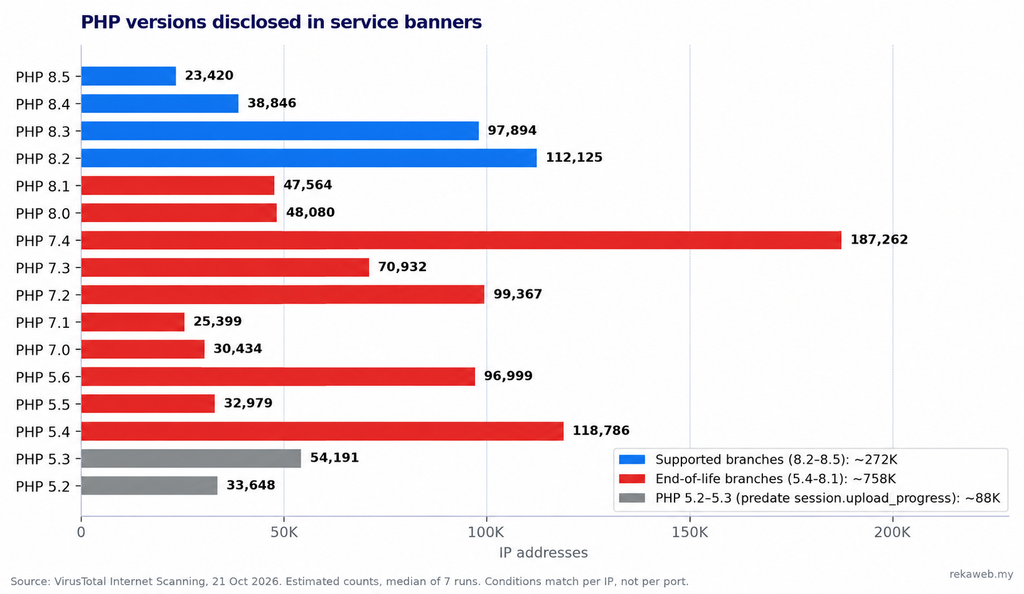
PHP powers a significant portion of the internet, including popular content management systems and custom web applications.
Platforms potentially exposed through vulnerable PHP installations include WordPress, Laravel, Drupal, Joomla, WooCommerce, and custom PHP applications.
Even a fully updated WordPress website could remain vulnerable if its underlying PHP runtime has not received the required security patches.
The actual exposure depends on the PHP version, server configuration, execution environment, and security controls.
This makes infrastructure-level security maintenance just as important as updating website plugins, themes, and application dependencies.
PHP Security Updates Released
The PHP development team released emergency fixes on October 21, 2026.
The patched versions include:
| PHP Branch | Patched Version |
|---|---|
| PHP 8.5 | 8.5.12 |
| PHP 8.4 | 8.4.27 |
| PHP 8.3 | 8.3.36 |
| PHP 8.2 | 8.2.35 |
Organizations running older PHP versions should prioritize migration to supported releases or verify whether their Linux distribution provides backported security fixes.
Server administrators should also be aware that package version numbers alone may not reflect the presence of vendor-maintained security patches.
How to Protect Your Web Server Against PHP2Shell
1. Apply PHP Security Patches
Review the PHP version installed on your server and apply the appropriate security updates.
Before upgrading a production environment, verify compatibility with existing WordPress plugins, Laravel applications, and other dependencies.
2. Audit Web Server Configurations
Review Apache, Nginx, PHP-FPM, and related configurations to identify unnecessary exposure and insecure settings.
Restrict sensitive files, administrative interfaces, and internal services wherever possible.
3. Monitor Suspicious HTTP Requests
Examine access logs, error logs, and application logs for unusual activity.
Repeated suspicious requests, unexpected file uploads, and attempts to execute system commands may indicate attempted exploitation.
4. Scan for Malware and Unauthorized Changes
Conduct regular security inspections to identify suspicious PHP files, web shells, unauthorized modifications, unexpected processes, and unusual outbound network connections.
5. Implement Web Application Firewall Protection
A Web Application Firewall (WAF) can help reduce exposure to automated scanning and known attack patterns.
However, WAF protection should complement security patching rather than replace it.
6. Maintain Reliable Server Backups
Create regular backups of website files, databases, and essential configurations.
Store backup copies separately from the production server and periodically test the restoration process.
Why Businesses in Malaysia Should Take This Threat Seriously
Businesses in Malaysia increasingly depend on websites and online systems for everyday operations.
Corporate websites, e-commerce stores, booking systems, customer portals, and government applications frequently rely on PHP-based technologies.
A successful server compromise could potentially result in website downtime, unauthorized access to customer information, service disruption, or financial losses.
For businesses operating WordPress or Laravel applications, regular server security audits should be part of their ongoing website maintenance strategy.
Security responsibilities extend beyond the website interface to include the operating system, PHP runtime, database, hosting environment, and backup infrastructure.
RekaShield: A Server Security Auditing Solution by Rekaweb Digital
As cybersecurity threats continue to evolve, identifying vulnerabilities before attackers exploit them becomes increasingly important.
RekaShield is a server security auditing application being developed by Rekaweb Digital to support security assessments of Linux-based web servers.
The project focuses on centralized security auditing through a Windows desktop interface, with planned capabilities covering server configuration reviews, application discovery, vulnerability findings, malware inspection, and security reporting.
Its approach is intended to help administrators assess the security posture of Ubuntu servers and PHP-based applications, including WordPress and Laravel.
RekaShield is under development and should not be considered a replacement for vendor security patches, endpoint protection, or professional incident response.
Conclusion
The PHP2Shell vulnerabilities demonstrate how quickly cybercriminals can respond to newly disclosed security weaknesses.
With millions of exploitation attempts reported and attackers attempting to distribute Mirai-related malware, PHP server administrators should prioritize security updates and infrastructure assessments.
Although widespread successful exploitation had not been confirmed in the reports available on October 23, 2026, researchers have demonstrated techniques capable of overcoming important exploit mitigations.
The most effective response is proactive security maintenance: patch vulnerable PHP installations, review server configurations, monitor suspicious activity, and maintain recoverable backups.
For businesses relying on WordPress, Laravel, and other PHP-powered applications, server security should remain an essential part of long-term website management.
About Rekaweb Digital
Rekaweb Digital is a Malaysia-based web development company providing website development, WordPress solutions, Laravel application development, hosting, and website maintenance services.
Website: https://rekaweb.my/en/
References
- The Hacker News — PHP2Shell Exploit Attempts Hit Millions as Attackers Try to Deploy Mirai Malware, October 23, 2026.
- Arctic Wolf Labs — PHP2Shell: Critical PHP Vulnerabilities Enable Unauthenticated Remote Code Execution, October 22, 2026.
- SecurityWeek — Mirai Botnet Operators Join PHP2Shell Attacks as ASLR Bypass Exploits Emerge, October 23, 2026.